Beyond Survival Mode: Sonya Achara on Trauma, Leadership, and Remembering Who You Are
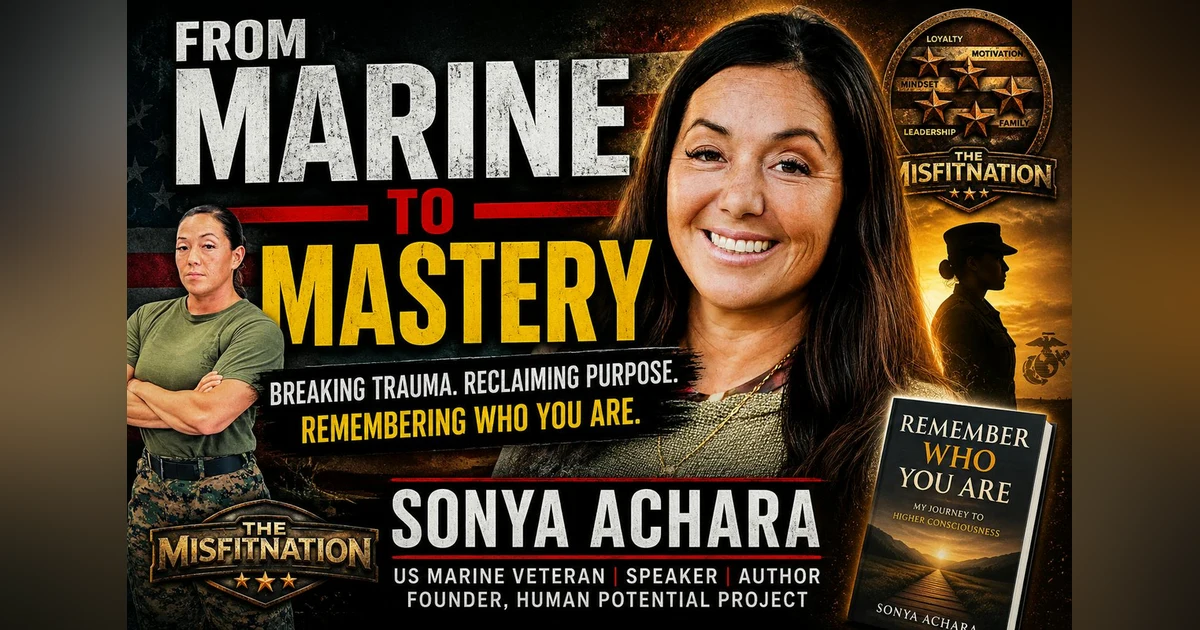
A former Marine Gunnery Sergeant reveals how unresolved trauma shapes leadership, relationships, identity, and the nervous system—and how veterans and high performers can begin to heal.

 Apple Podcasts
 Spotify
 Castro
 RSS Feed
 Amazon Music
 TuneIn
 Gaana
Gaana 
 RadioPublic
 What happens when the mission ends, the uniform comes off, and the survival skills that once made you strong begin working against you?
In this powerful episode of The MisFitNation, host Rich LaMonica sits down with Sonya Achara, a United States Marine Corps veteran, former Gunnery Sergeant, author, speaker, and founder of the Human Potential Project.
Sonya served 14 years in the Marine Corps, including a deployment to Afghanistan, recruiting duty in Kansas, leadership assignments at Camp Lejeune and Camp Pendleton, and service as a Force Fitness Instructor Trainer at the Martial Arts and Fitness Center of Excellence.
Throughout her career, she became known for discipline, physical strength, motivation, and leadership. She served as a radio operator, martial arts instructor, marksmanship coach, recruiter, bodybuilding competitor, mentor, and senior enlisted leader.
But beneath that strength were emotional and subconscious patterns she did not yet fully understand.
After leaving the military while also ending a toxic relationship, Sonya faced a new battle: discovering who she was beyond the Marine Corps, beyond constant performance, and beyond survival mode.
That journey led her to study the nervous system, emotional intelligence, subconscious conditioning, attachment styles, neuroscience, human consciousness, and transformational leadership.
In this conversation, Sonya explains how childhood experiences, military conditioning, toxic relationships, and unresolved trauma can influence the way people lead, love, react, perform, and view themselves.
She also challenges the idea that relentless discipline, hyper-independence, emotional suppression, and constant achievement are always signs of strength. In some cases, they may be survival responses hiding in plain sight.
Sonya shares how a difficult childhood shaped her desire to find belonging through athletics and the Marine Corps. She reflects on the leadership lessons she learned from both effective and ineffective leaders and explains why genuine leadership is rooted in consistency, humility, example, trust, and care—not fear, rank, or intimidation.
She also discusses how recruiting duty changed her understanding of influence. She could not force anyone to join the Marine Corps. She had to inspire people through the way she carried herself, the relationships she built, and the standard she modeled.
The episode explores how the nervous system can become stuck in fight-or-flight mode and why people often repeat unhealthy relationship patterns. Sonya explains that people frequently choose what feels familiar rather than what is actually healthy.
That insight became a turning point in her own healing.
Through self-awareness, accountability, emotional regulation, boundaries, compassion, and nervous-system work, Sonya began changing patterns that had followed her from childhood into the military, relationships, leadership, and motherhood.
She shares how this work transformed the way she responds to conflict, co-parents, listens, sets boundaries, and repairs connection after emotional reactions.
Sonya also discusses the difference between understanding trauma intellectually and actually embodying change. Knowing why a pattern exists is not the same as recognizing it in real time and choosing a healthier response.
The conversation also addresses a question many military families struggle with: How do you support a veteran who refuses to talk about what they are going through?
Sonya’s advice is simple but important: do not force disclosure, do not try to fix everything, and do not underestimate the power of consistent presence.
Sometimes the most meaningful support is listening without judgment, pressure, interruption, or an immediate solution.
This episode is for veterans, first responders, military families, leaders, parents, high performers, and anyone who has spent years believing they must carry everything alone.
It is an invitation to examine whether your discipline comes from purpose or from a need to prove your worth.
It asks whether your relationships are built on security or familiarity.
Most importantly, it reminds listeners that the patterns they developed to survive are not necessarily who they truly are.
In This Episode
Sonya and Rich discuss:
Her journey from a difficult childhood to collegiate athletics and the Marine Corps
Why she chose the toughest military branch
Her experience as a radio operator, recruiter, martial arts instructor, marksmanship coach, bodybuilder, and Gunnery Sergeant
Her deployment to Camp Dwyer in Afghanistan’s Helmand Province
How hypervigilance can develop before military service and intensify during it
The difference between fear-based leadership and authentic leadership
Why yelling, humiliation, and intimidation do not build strong teams
The emotional impact of leaving the military and a toxic relationship at the same time
How childhood experiences shape adult relationships
Why people often confuse familiarity with safety
Anxious, avoidant, disorganized, and secure attachment patterns
What it means to live in survival mode
How emotional suppression can lead to explosive reactions
The difference between intellectual understanding and embodied healing
How boundaries and accountability improve relationships
The role of repair after conflict
Why constant achievement may be connected to unresolved trauma
How veterans and high performers can lose themselves in performance
Why some people listen to respond instead of listening to understand
How families can support veterans who do not want to talk
Why vulnerability can create safety for others
The importance of humility, compassion, and personal responsibility
Key Takeaways
Strength is not emotional suppression.
Real strength includes recognizing, processing, and communicating what you feel.
Familiar does not always mean safe.
People often repeat unhealthy patterns because those patterns resemble what their nervous system already knows.
Leadership is demonstrated through behavior.
Trust, consistency, humility, compassion, and example influence people more effectively than fear.
Healing requires accountability.
Understanding where a pattern came from does not remove responsibility for changing it.
You cannot force someone to open up.
Supporting a veteran may begin with patience, compassion, presence, and listening.
Discipline can come from purpose or pain.
Achievement may be meaningful, but it can also be driven by fear, shame, insecurity, or the belief that worth must be earned.
Repair matters.
Healthy relationships do not require perfection. They require honesty, accountability, and reconnection after conflict.
Your patterns are not your identity.
The responses that helped you survive may not reflect who you are capable of becoming.
About Sonya Achara
Sonya Achara is a United States Marine Corps veteran, former Gunnery Sergeant, author, speaker, and transformational leader.
She is the founder of the Human Potential Project and the author of Remember Who You Are: My Journey to Higher Consciousness.
Her work helps veterans, first responders, leaders, and high performers identify subconscious survival patterns, regulate their nervous systems, strengthen emotional intelligence, build healthier relationships, and reconnect with purpose.
She also hosts the Identity Recode Masterclass, focused on subconscious patterns, healing, relationships, leadership, and personal transformation.
Connect With Sonya Achara
Website: sonyaachara.com
Instagram: @rememberwhoyouare
Facebook: Sonya Achara
Connect With The MisFitNation
Visit themisfitnation.com for past episodes, community updates, guest interviews, and MisFitNation merchandise.
Follow the show for more conversations with veterans, first responders, authors, entrepreneurs, athletes, leaders, and changemakers who have transformed adversity into purpose.
What survival pattern have you mistaken for part of your personality?
Share this episode with a veteran, leader, parent, first responder, or high performer who needs the reminder that healing is possible.
Be humble. Stay hungry. Keep hustling. Because we are MisFitNation.
Learn more about your ad choices. Visit megaphone.fm/adchoices